555 Timer Test Software
Posted : adminOn 3/20/2018There are a few 555 timer design software applications that will help you in your projects. Component value calculations for the 555 take into account the. This simple IC 555 timer tester not only tests IC 555 in all of its basic configurations. The timer under test automatically gets wired as. LATEST SOFTWARE.
Background Im a beginner in the field of electonics, and I have been trying to put together a IR remote control / laser tag system using Arduino Nano. I am using a TSOP4840 receiver and a TSAL6100 as the emitter, so I need a modulated signal at 40kHz. To do that, I tried to use a NE555timer and use and 'and it' with my arduino output pin using a 74HCT08 IC.
I made a breadboard circuit. Here's a photo of it: Unfortunately, the timer does not work. Its output pin is always at 0V compared to the GND. I tried a few different timer IC's, none of them worked. I made a second circuit, on another breadboard and using another 555 timer, wiring everything up as in the first circuit, none of it helped.
Question Following the NE555 timer datasheet, I tried to create a test circuit for it, but it didn't work, always having 0V between the output pin and GND. I used different breadboards and timer IC's.
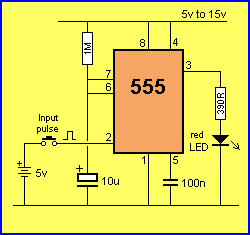
How can I identify my mistake/the faulty part of the circuit? I'm quite sure I wired up everything as it was shown in the datasheet. Here is the timers pin layout, the schematic from the datasheet and a picture of my circuit. Edit the mistake on the photo (yellow wire connected to pin 3 instead of 2) has been corrected, but was not the source of the problem. In the original circuit (top photo) I didnt make that mistake.
@SpehroPefhany yeah, thats the one-row mistake I made, the yellow wire should be connected to the 2nd pin, not the third. I corrected it, but it did not fix the issue - also, it was fine in the first circuit. After correcting that mistake, I followed your advice and put in an 1.2kOhm R1. I changed the R2 to 100kOhm to have a near 50% split between high and low state and adjusted the capacitor to remain around 40kHz modulation. This seemed to fix the issue - the timer output works now:) I'll check it with an oscilloscope once I get my hands on one. Thanks for help!
– Apr 24 '14 at 19:47. • You have no schematic • You have no caps near 555 or on led driver chip, Vcc • You have no current limiting resistor for 1.3V IR LED • No floating CMOS inputs allowed, period. • If LED is direct to driver, it may exceed AGC range of Rx and saturate at close range. Bounce off ceiling if using short circuit cuurent from NAND gate shud work. • You have no test results on voltage of every pin of schematic? Graffiti Fonts Edition 2 0: Software Free Download.
After you get experience, you can walk around every pin, like a dental checkup and figure it out fast. Ensure you understand the logic trigger states are met Where is your DMM?
Ne555 is one of the most commonly used timer IC. It is a monolithic timing that can produce accurate and highly stable time delays or oscillations. Like general purpose OP AMPs, it is very much reliable, easy to use and cheaper in cost.